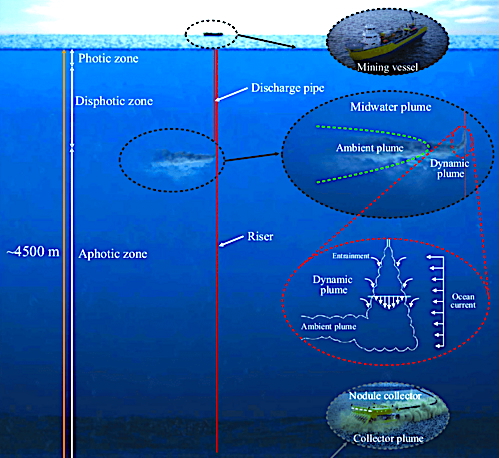


![Schematic of a polymetallic nodule mining operation. From top to bottom, the three zoom-in panels illustrate the surface operation vessel, the midwater sediment plume, and the nodule collector operating on the seabed. The midwater plume comprises two stages: (i) the dynamic plume, in which the sediment-laden discharge water rapidly descends and dilutes to a neutral buoyancy depth, and (ii) the subsequent ambient plume that is advected by the ocean current and subject to background turbulence and settling.[1] Image: Wikipedia Commons, Kredit: Carlos Muñoz-Royo.](https://www.miningmetalnews.com/sites/default/files/styles/content_media_slider/public/media-cover-images/schematic-of-a-polymetallic-nodule-mining-operation-from-top-to-bottom-the-three_2_0.jpg?h=3df05eba&itok=mQ4IHM6z&u=1776673036)
United States is stepping up efforts to enable mining on the ocean floor, including in international waters. The move is driven by rising demand for critical minerals used in batteries, electronics and military systems.
At the same time, supply chains are heavily dominated by China, increasing geopolitical pressure on Western countries to secure alternative sources. The deep sea is increasingly viewed as a potential resource, despite limited real-world experience with large-scale extraction.
Finnish expert Simon Holmström from the environmental organisation Seas at Risk warns about the direction of developments.
– The United States wants to accelerate mining even in international waters. These areas are governed by international law and the International Seabed Authority, he told Yle.
According to Holmström, US policy under Donald Trump risks triggering an uncontrolled rush for seabed resources.
Growing opposition and paused projects
So far, exploration has mainly taken place within national economic zones. Norway was among the first countries to plan deep-sea mining, but has now paused its projects until 2029 following criticism and environmental concerns.
More than 40 countries have expressed opposition or strong scepticism. Finland joined this position in 2023.
Meanwhile, negotiations continue within the International Seabed Authority over the rules that would govern potential commercial extraction. The issue remains unresolved and politically sensitive.
Banks are reluctant amid uncertainty
Despite political momentum, financing remains uncertain. A report by Seas at Risk and Deep Sea Mining Campaign shows that nearly two-thirds of 132 surveyed financial institutions are hesitant to fund deep-sea mining.
Participants include the Asian Development Bank, the European Bank for Reconstruction and Development and Deutsche Bank.
The potential capital pool for investments is estimated at around 24 trillion euros, but uncertainty over environmental impacts, regulation and technical feasibility is slowing decisions.
– It was like a powerful vacuum cleaner where material is simply sucked from the seabed. Interest was high despite limited understanding of how complex the operation is, said Daniel Sailer of Metzler at a seminar in Brussels.
Holmström highlights several key risks.
– The main issue is uncertainty. Environmental impacts are not well understood and may be irreversible. Banks do not lend to projects with such high risks. There is also a lack of clear rules and concerns about reputational damage, he said.
Deep-sea mining would involve disturbing ecosystems that are still largely unexplored. Scientists warn that sediment plumes and seabed disruption could affect entire biological systems, with consequences that may be difficult to predict or reverse.
At the same time, alternatives such as recycling, more efficient material use and circular solutions are being highlighted as ways to reduce the need for new extraction in complex and high-risk environments.
Despite this, pressure remains from industry and governments to secure access to critical minerals. How quickly deep-sea mining could become a reality remains uncertain.
Source: Yle
Fact check
Deep-sea mining involves extracting minerals from the ocean floor, often at depths of several thousand metres. The technology is still developing and carries significant technical, economic and environmental risks. Scientific understanding of impacts on marine ecosystems remains limited.
Image caption: Schematic of a polymetallic nodule mining operation showing a surface vessel, midwater sediment plume and seabed collector. The plume includes a dynamic phase and a dispersed phase influenced by currents and sedimentation. Credit: Carlos Muñoz-Royo / Wikimedia Commons.