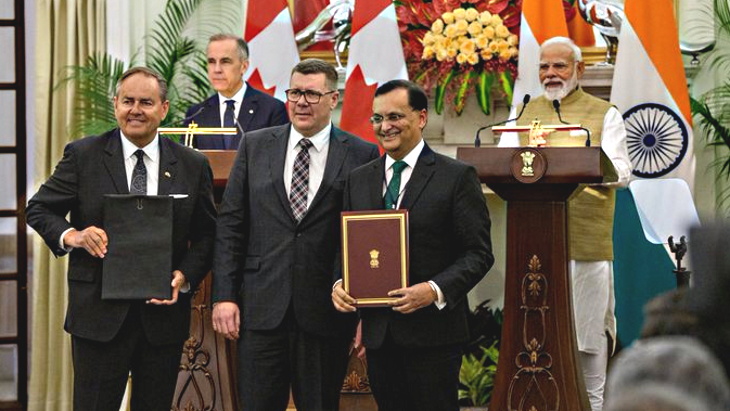


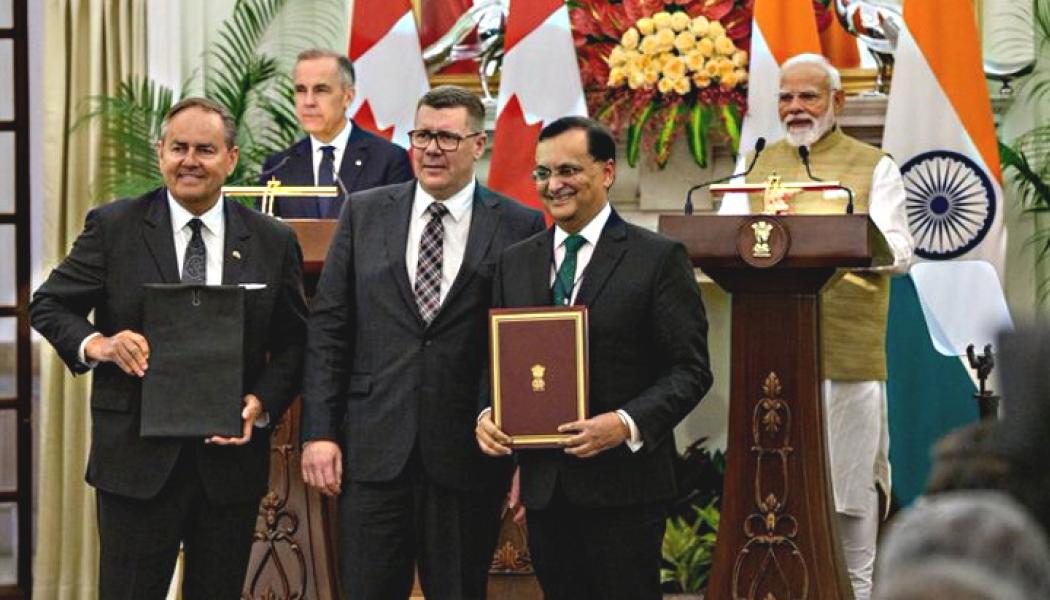
Canadian uranium producer Cameco has signed a long-term agreement to supply uranium ore concentrate to India’s Department of Atomic Energy (DAE), in a deal valued at approximately CAD2.6 billion.
The agreement covers deliveries between 2027 and 2035 and includes nearly 22 million pounds of U3O8, which will be used to fuel India’s expanding fleet of nuclear reactors. Pricing is linked to market conditions.
The deal was signed during an official visit in which Canadian Prime Minister Mark Carney met Indian Prime Minister Narendra Modi in Mumbai and New Delhi. Canada remains one of the world’s largest uranium producers, while India is among the fastest-growing nuclear energy markets.
Rising demand drives long-term contracts
India currently operates 24 nuclear reactors and has outlined plans to significantly expand capacity, targeting 100 gigawatts of installed nuclear power by 2047.
Cameco CEO Tim Gitzel emphasised the importance of a stable fuel supply in meeting these ambitions.
– Cameco is proud to be a strategic partner with India to help meet its civil nuclear fuel needs and support its trade relationship with Canada, he said, according to the company.
– India is embarking on an ambitious nuclear expansion to power its development plans and meet future energy security needs. That is not possible without a stable supply of uranium fuel, Gitzel added.
He also pointed to a broader shift in the market, where state-backed buyers are securing long-term supply agreements amid growing uncertainty.
– Demand continues to rise while available supply is becoming more constrained, he said.
Competition intensifies among suppliers
Canada is not the only country seeking to strengthen uranium exports to India. Kazakhstan’s state-owned company Kazatomprom has recently announced plans to secure shareholder approval for a similar long-term agreement with India’s Department of Atomic Energy.
The proposed deal includes the delivery of uranium concentrates, although details on pricing, volumes and delivery schedules remain confidential. The transaction is significant enough to require shareholder approval under Kazakh law, as it represents at least 50 per cent of the company’s total asset value.
India’s procurement is handled by the Directorate of Purchase & Stores, a centralised body responsible for sourcing and managing materials for the country’s nuclear sector.
Strategic role of uranium in energy systems
Uranium is a key fuel for nuclear power, which provides stable electricity generation independent of weather conditions. This makes it an important component in energy systems facing rising demand from industrial electrification and digital infrastructure.
At the same time, long-term supply agreements are increasingly locking in large portions of global uranium production. This can reduce availability on the spot market and contribute to price volatility.
While nuclear energy is often highlighted for its ability to deliver continuous power, its expansion depends heavily on reliable fuel supply chains, regulatory approvals and long development timelines.
Source: World Nuclear News
Fact check:
Canada and Kazakhstan are among the world’s largest uranium producers. India’s nuclear expansion plans are among the most ambitious globally, reflecting rising electricity demand and the need for stable baseload generation.